
Wanting to last longer during sex is a common concern, but it doesn’t mean there’s something wrong with you. Sexual experiences vary widely, and there isn’t one specific number of minutes that everyone needs to reach.
How quickly someone ejaculates can be influenced by many things. Arousal, anxiety, sensitivity, stress, relationship dynamics, sexual habits, erectile concerns, and even certain physical or medical conditions can all play a role.
The good news is that ejaculation control isn’t necessarily something you’re either born with or without. For some men, becoming more aware of their arousal and changing a few habits can make a noticeable difference over time.
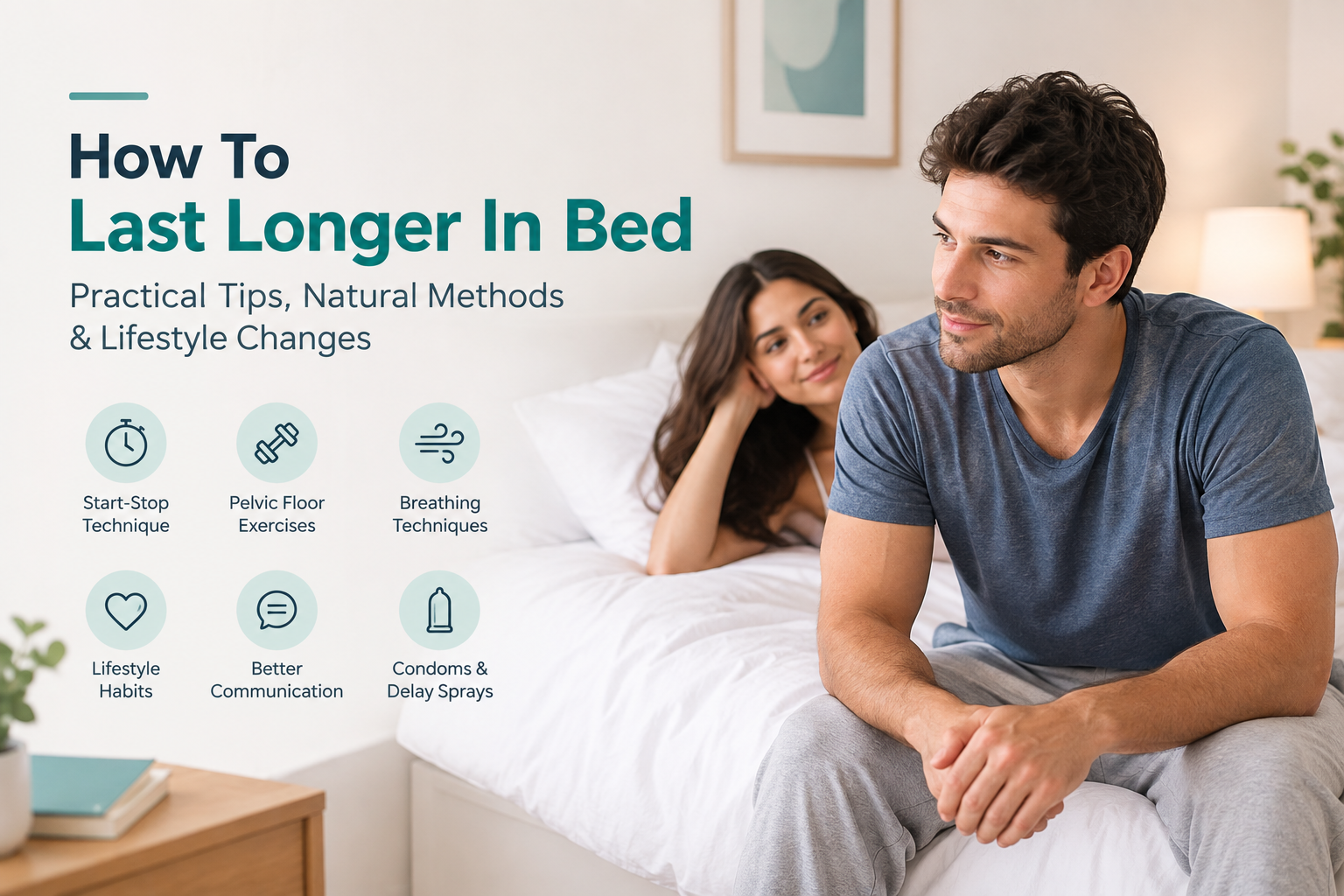
In this guide, we’ll look at practical ways to how to last longer in bed naturally, including the start-stop technique, pelvic floor exercises, breathing, lifestyle habits, communication, condoms, and delay sprays. We’ll also cover when finishing sooner than you’d like may be a sign that it’s worth speaking with a healthcare professional.
What Does “Lasting Longer in Bed” Actually Mean?
“Lasting longer” sounds straightforward, but it means different things to different couples. Sex isn’t a stopwatch exercise. Reaching a particular number of minutes doesn’t automatically mean you’ve had satisfying sex, just as finishing sooner on one occasion doesn’t necessarily mean you have premature ejaculation.
What matters more is whether you feel able to control ejaculation, whether the experience is satisfying for both partners, and whether the timing is causing ongoing frustration or distress.
How Long Does Sex Usually Last?
There is considerable variation in how long intercourse lasts from one person or couple to another. Even the same person may experience different timing depending on their level of arousal, stress, stimulation, relationship context, and circumstances. So instead of comparing yourself with a number you’ve seen online, pay attention to your own experience.
When Is Early Ejaculation a Concern?
Occasionally ejaculating sooner than you wanted is usually not a reason to panic. It becomes more worth addressing when ejaculation happens sooner than desired on a persistent basis, feels difficult to control, and causes significant frustration, distress, or relationship difficulties.
If that’s happening regularly, it’s reasonable to look beyond quick fixes and consider whether premature ejaculation or another sexual health issue could be involved.
What Can Make You Ejaculate Too Quickly?
There isn’t always one obvious reason. Some men may become highly aroused very quickly. Others may find that anxiety or pressure makes it harder to stay in control. Stress, relationship difficulties, increased sensitivity, erectile concerns, and learned sexual habits can also influence ejaculation.
Performance Anxiety
Thinking, “I hope I don’t finish too soon” can ironically make it harder to stay relaxed.
When you’re focused on monitoring your performance, your body may become tense and your attention shifts away from what’s actually happening. That extra pressure can make rising arousal feel even harder to manage.
High Sexual Arousal and Sensitivity
For some men, the problem is simply that arousal rises very quickly. Once you get close to the point where ejaculation feels inevitable, trying to stop at that stage can be difficult. Learning to notice the earlier signs of rising arousal gives you more opportunity to slow things down before you reach that point.
Stress, Fatigue, and Relationship Factors
Your mental and emotional state can influence your sexual experience. A stressful week, poor sleep, relationship tension, or feeling disconnected from your partner can affect arousal and confidence. That doesn’t mean premature ejaculation is always psychological. Physical and medical factors can matter too.
The point is that sexual function doesn’t happen separately from the rest of your life.
How To Last Longer in Bed Naturally
If you’re looking for ways to last longer in bed, start with techniques you can practice rather than expecting one trick to solve everything immediately.
Use the Start-Stop Technique
The start-stop technique is based on learning to recognize when your arousal is getting close to the point where ejaculation feels difficult to control. When you notice yourself approaching that point, pause stimulation and give your arousal time to settle. Once you feel more in control, you can resume.
With regular practice, this can help you become more familiar with your arousal pattern and recognize the warning signs earlier. The important part is not waiting until you’re already at the point of no return. The goal is to learn your body’s signals before control is almost gone.
Try the Squeeze Technique
The squeeze technique uses a brief reduction in stimulation when ejaculation feels close. The basic idea is to pause and temporarily reduce stimulation, allowing arousal to come down before continuing.
Like the start-stop technique, it isn’t supposed to be a one-time magic trick. It may take practice to understand when to use it and how your body responds.
Slow Down and Control Your Breathing
When arousal rises, it’s easy to unconsciously tense your muscles or start breathing faster. Try slowing your breathing and deliberately relaxing your body. Pay attention to areas where you tend to hold tension, rather than trying to force yourself not to ejaculate. Slower breathing can also help take some of the urgency out of the moment.
Pay Attention to Your Arousal Level
One of the most useful skills you can develop is simply noticing what’s happening before ejaculation feels unavoidable. Think of arousal as a rising scale rather than an on/off switch. If you only pay attention when you’re already at the highest point, you have fewer opportunities to adjust.
Learning to recognize earlier changes in sensation and arousal can make techniques such as slowing down or pausing much easier to use.
Pelvic Floor Exercises for Better Ejaculation Control
The pelvic floor muscles are involved in sexual function, and learning how to contract and relax them properly may help some men develop better muscular awareness and control.
How To Identify the Pelvic Floor Muscles
One way to understand which muscles you’re looking for is to notice the muscles you would use to prevent yourself from passing gas. You can also briefly identify the muscles involved in stopping urine flow, but repeatedly interrupting your urine stream as an exercise isn’t recommended.
Once you’ve identified the muscles, practice them separately from urination.
How To Perform Kegel Exercises Correctly
Contract the pelvic floor muscles gently and deliberately, then relax them fully before the next repetition. The goal isn’t to squeeze as hard as possible. Controlled contractions and complete relaxation between repetitions are more useful than constantly keeping the muscles clenched. Consistency matters more than doing a huge number of repetitions once in a while.
Why Relaxation Matters Too
Pelvic floor training isn’t only about strengthening.
Some men may spend a lot of time unconsciously tightening these muscles, particularly when they’re anxious or highly aroused. Constant clenching isn’t necessarily helpful. Learning when to contract and, just as importantly, when to relax can be part of developing better control.
Lifestyle Habits That May Help You Last Longer
Sexual function is closely connected with overall health, so everyday habits can matter even if they don’t directly “treat” premature ejaculation.
Exercise Regularly
Regular physical activity supports cardiovascular health, fitness, stress management, and general wellbeing—all of which can contribute to healthier sexual function.
You don’t need a complicated workout plan. Consistent movement and exercise are more useful than searching for a single exercise that promises to make you last longer.
Manage Stress and Sleep Better
Stress can affect arousal, confidence, and sexual performance. Poor sleep can leave you physically tired and mentally less relaxed. Getting enough sleep and finding practical ways to manage stress may not solve ejaculation difficulties on their own, but they can create a better foundation for sexual health.
Limit Excessive Alcohol and Smoking
Alcohol isn’t a reliable way to delay ejaculation. While it may temporarily change sensation or reduce inhibitions, heavy drinking can negatively affect sexual function.
Smoking can also affect overall sexual health. Reducing excessive alcohol use and avoiding smoking are better viewed as general health measures rather than tricks for lasting longer.
Maintain a Healthy Weight and Balanced Diet
A balanced diet and healthy body weight support metabolic and cardiovascular health, which are important for overall sexual wellbeing. There isn’t one particular food that can guarantee better ejaculation control. Think in terms of your overall health rather than searching for a “magic” food for premature ejaculation.
Can Masturbation Habits Affect How Long You Last?
Masturbation itself doesn’t automatically cause premature ejaculation. However, the way you masturbate may influence your arousal patterns. If you’re used to rushing, using very intense stimulation, or trying to finish as quickly as possible, you may become less familiar with slower changes in arousal.
For some men, experimenting with slower, more controlled stimulation and paying attention to rising arousal may help build greater awareness.
The goal isn’t to treat masturbation as a problem. It’s to understand your habits and notice whether they leave you with enough awareness of your body’s signals.
How Communication With Your Partner Can Help
Sexual performance can become much harder when it starts feeling like an exam. If you’re constantly worrying about how long you’re going to last, that pressure can make it even harder to stay relaxed. Talking openly with your partner can take some of that pressure away.
Take the Pressure Off Penetration Time
Intercourse duration isn’t the only measure of sexual satisfaction.
Intimacy, stimulation, communication, affection, and mutual pleasure all matter. When couples stop treating penetration time as the entire definition of “good sex,” there can be less pressure to perform for a specific number of minutes.
Talk About What Feels Comfortable
Simple communication can make a practical difference.
Partners can talk about pace, stimulation, pauses, and what feels comfortable. It also becomes easier to adjust things when both people understand that the goal is shared satisfaction rather than one person trying to meet a stopwatch target.
Do Delay Sprays Help You Last Longer in Bed?
Delay sprays are another option some men use when they have difficulty controlling ejaculation. Many contain local anesthetics such as lidocaine or benzocaine, which temporarily reduce penile sensitivity.
How Delay Sprays Work
The basic idea is fairly simple: less sensitivity can mean less intense stimulation. For some men, that temporary reduction in sensation may provide more time to recognize rising arousal and manage it before ejaculation.
But the goal shouldn’t be to eliminate sensation. Too much numbing can reduce pleasure and may make sexual activity less enjoyable.
How To Use a Delay Spray Correctly
Always follow the instructions for the specific product you’re using. Different delay sprays can contain different active ingredients and concentrations, so there isn’t one universal number of sprays or one waiting time that applies to all products. Generally, users should:
- Apply only the recommended amount
- Use it only on the area specified by the manufacturer
- Allow the stated amount of time for the product to work
- Remove excess product when the instructions tell you to
- Check whether the product has specific condom-use instructions
Using more spray doesn’t automatically mean better ejaculation control.
Possible Side Effects and Precautions
Too much topical anesthetic can cause excessive numbness, reduced pleasure, irritation, or discomfort. There is also a possibility of transferring residual product to a partner, which may cause temporary numbness.
If you experience a significant reaction or persistent irritation, stop using the product and seek appropriate medical advice.
Can Condoms Help You Last Longer?
For some men, condoms can reduce the intensity of sensation during sex, which may make ejaculation easier to control. Standard condoms may provide some reduction in sensitivity, while certain products are specifically designed or marketed to provide additional sensitivity reduction.
However, the experience varies. Fit, material, comfort, and individual sensitivity can all affect how a condom feels. A condom shouldn’t be treated as a guaranteed solution, but it can be one practical option to consider.
What About Medicines for Premature Ejaculation?
Men with persistent premature ejaculation may have medical treatment options beyond topical products.
Certain prescription treatments may be considered depending on the individual’s symptoms and underlying factors. However, these aren’t suitable for everyone and shouldn’t be started without discussing them with a qualified healthcare professional.
The appropriate treatment depends on what is contributing to the problem. For some men, behavioral approaches may be useful; others may benefit from counseling, medication, or a combination of approaches.
Common Mistakes Men Make When Trying To Last Longer
Sometimes the biggest improvement comes from stopping the things that aren’t helping.
Trying To Completely Stop Feeling Sensation
Completely eliminating sensitivity isn’t the goal. Too much numbing can reduce sexual pleasure and may even make it harder to maintain an erection or enjoy the experience.
Using Too Much Delay Spray
More product doesn’t necessarily mean more control. Follow the instructions for your particular product instead of increasing the amount because the initial effect doesn’t seem strong enough.
Focusing Only on Penetration Duration
Sexual satisfaction isn’t measured by penetration time alone. Putting all your attention on the clock can create unnecessary pressure and distract from intimacy and communication.
Ignoring Persistent Problems
If you’re repeatedly dealing with premature ejaculation, erection difficulties, anxiety, pain, or other symptoms, constantly trying random products may only postpone getting useful answers. Persistent problems deserve a proper look at what’s causing them.
When Should You See a Doctor About Ejaculation Problems?
If ejaculating sooner than you’d like happens occasionally, you may not need to be concerned. But professional advice is worth considering when the problem is persistent, difficult to control, or causing significant distress. You should especially consider an evaluation if:
- You consistently ejaculate sooner than you want
- You feel unable to control ejaculation
- The issue is causing significant distress
- It is affecting your relationship
- The problem appeared suddenly after previously normal sexual function
- You also have erection difficulties
- You experience genital pain or another physical symptom
- Topical products or behavioral techniques aren’t helping
- You feel that you need increasingly large amounts of anesthetic products
A doctor or sexual-health professional can help determine whether the issue is related to premature ejaculation, erectile problems, medications, psychological factors, or another underlying condition.
How To Build Better Ejaculation Control Over Time
Improving ejaculation control is usually more realistic when you think of it as a skill rather than a quick fix. Start by paying attention to your arousal pattern. Notice what happens before you reach the point where ejaculation feels unavoidable.
From there, you can practice techniques such as start-stop, work on pelvic floor awareness, improve your breathing and stress management, and communicate openly with your partner. If you want to try a delay spray or another product, use it correctly rather than simply increasing the amount.
And if the problem continues despite these efforts, don’t feel that you have to keep experimenting on your own. Professional guidance can help identify what may actually be driving the problem.
Most importantly, give yourself time. One technique may not produce a dramatic difference immediately, and that’s okay. Consistent practice and a broader approach are often more useful than chasing an instant solution.
Final Takeaway
Learning how to last longer in bed isn’t really about reaching an exact number of minutes. It’s about understanding your arousal, recognizing when you’re getting close to ejaculation, and having enough control to slow things down when you need to.
Start-stop techniques, pelvic floor training, healthier lifestyle habits, controlled breathing, communication, condoms, and appropriately used delay products can all be options worth exploring. For men dealing with persistent premature ejaculation, however, a broader evaluation may be more useful than relying on one technique or product.
If you’re specifically interested in delay sprays, you can also explore our Best Delay Spray guide to understand how different products and formulations compare.
FAQs
1. How can I last longer in bed naturally?
Start by learning to recognize your arousal level. Techniques such as the start-stop method, controlled breathing, slower stimulation, pelvic floor training, stress management, and better communication with your partner may help improve ejaculation control over time.
2. What is the best exercise to last longer in bed?
There isn’t one exercise that works for everyone. Pelvic floor exercises may help some men develop better muscular awareness and control, particularly when they focus on both controlled contractions and relaxation.
3. Does the start-stop technique really work?
The start-stop technique can help some men become more aware of rising arousal and practice delaying ejaculation. It generally takes repeated practice rather than working as an instant solution.
4. Can Kegel exercises help men last longer?
Kegel exercises may help some men improve awareness and control of their pelvic floor muscles. However, constantly tightening the muscles isn’t the goal; learning to relax them properly is also important.
5. Can stress make you finish too quickly?
Stress and performance anxiety can affect arousal and sexual control for some men. However, premature ejaculation can have multiple contributing factors, so stress isn’t necessarily the only cause.
6. Do condoms help you last longer?
Condoms may reduce sensation for some men and can therefore help with ejaculation control. Individual responses vary depending on factors such as condom material, fit, and sensitivity.
7. Do delay sprays actually help you last longer?
Delay sprays may help some men by temporarily reducing penile sensitivity. They aren’t a guaranteed solution, and using too much can cause excessive numbness and reduced pleasure.
8. How long before sex should you use a delay spray?
The timing depends on the specific product. Always follow the manufacturer’s instructions because different formulations can have different waiting periods.
9. Can masturbation help improve ejaculation control?
Masturbation itself doesn’t automatically cause or cure premature ejaculation. However, some men may benefit from practicing slower, more controlled stimulation and becoming more aware of their arousal patterns.
10. Is it normal to ejaculate quickly sometimes?
Yes. Occasional early ejaculation can happen and doesn’t necessarily mean you have premature ejaculation.
11. What is the difference between premature ejaculation and occasionally finishing early?
Premature ejaculation generally involves a persistent pattern of ejaculating sooner than desired, difficulty controlling ejaculation, and associated distress or relationship difficulties. Finishing earlier than planned occasionally is much more common and doesn’t automatically indicate a disorder.
12. When should I see a doctor about ejaculating too quickly?
Consider speaking with a healthcare professional if the problem happens consistently, causes distress, affects your relationship, appears suddenly, occurs alongside erection problems or pain, or doesn’t improve with appropriate self-help measures.