
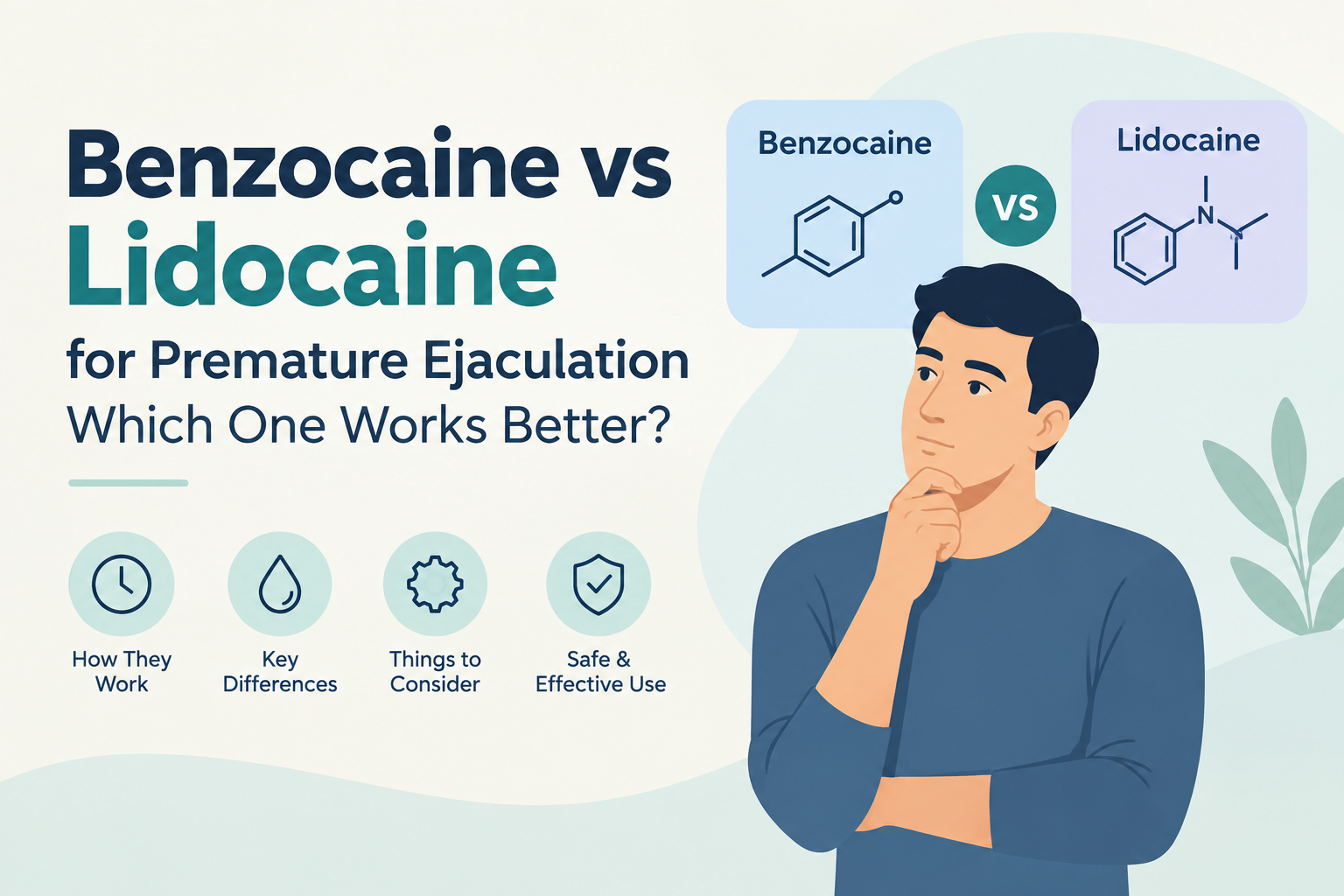
When premature ejaculation becomes a regular concern, many men look for ways to reduce sensitivity and feel more in control during sex. Topical anesthetics are one option. They work locally by temporarily reducing sensation, and two ingredients you may come across in delay sprays, gels, and creams are benzocaine and lidocaine.
At first glance, they may seem interchangeable. Both are local anesthetics, and both can reduce sensitivity when used in an appropriate topical formulation. But that doesn’t mean every benzocaine product or every lidocaine product will feel or work exactly the same.
The formulation, concentration, application method, waiting time, and your individual response can all make a difference. So, when comparing Benzocaine vs Lidocaine for Premature Ejaculation, it is more useful to understand how each works and what to look for in the finished product rather than simply asking which ingredient is “stronger.”
What Are Benzocaine and Lidocaine?
Before comparing the two, it helps to understand what these ingredients actually do.
What Is Benzocaine?
Benzocaine is a local anesthetic. When applied to the skin in an appropriate formulation, it temporarily reduces sensation in the area where it is used. It is found in a variety of topical products, including some sexual wellness products designed to reduce penile sensitivity. By making stimulation feel less intense, a benzocaine-containing product may help some men delay ejaculation.
What Is Lidocaine?
Lidocaine is another local anesthetic that is widely used in medical and topical products. In an appropriately formulated delay product, it can temporarily reduce sensation when applied to the penis.
Lidocaine is also available in different formulations and concentrations, so the experience with one lidocaine spray cannot automatically be applied to every other lidocaine product.
What Do They Have in Common?
Both benzocaine and lidocaine can:
- Temporarily reduce local sensitivity
- Be included in topical formulations
- Potentially help some men delay ejaculation
- Cause excessive numbness if too much is used
- Cause irritation or other unwanted reactions in some people
The important point is that the active ingredient is only one part of the product. The rest of the formulation and how it is used matter too.
How Do Benzocaine and Lidocaine Help With Premature Ejaculation?
Both ingredients work by temporarily reducing the intensity of certain nerve signals from the treated area. In simple terms, stimulation may feel less intense after the anesthetic takes effect.
Temporary Desensitization
Premature ejaculation can sometimes be associated with a high level of sensitivity during sexual stimulation. Reducing that sensitivity temporarily may give a man more time to recognize rising arousal and adjust his stimulation or pace. The aim, however, isn’t to make the penis completely numb.
How Reduced Sensitivity May Help
When stimulation feels less intense, some men may find it easier to stay below the point where ejaculation feels unavoidable. That can create a little more room for techniques such as slowing down, changing stimulation, using controlled breathing, or taking a short pause.
They Don’t Address Every Cause of Premature Ejaculation
Premature ejaculation isn’t always simply a matter of sensitivity. Anxiety, performance pressure, relationship factors, learned sexual patterns, and other health-related factors can also play a role. For that reason, a topical anesthetic can be useful for symptom management for some men, but it shouldn’t automatically be viewed as a complete treatment.
Benzocaine vs Lidocaine for Premature Ejaculation
So, how do benzocaine and lidocaine actually compare?
1. Mechanism of Action
Both are local anesthetics, but they are chemically different substances. Their shared purpose in a delay product is to temporarily reduce sensation in the area where they’re applied. You don’t necessarily need to understand the pharmacology in detail to use them safely—the product’s instructions are much more important in practice.
2. Onset of Action
One common question is which ingredient works faster. There isn’t a single answer that applies to every benzocaine or lidocaine product. The onset can depend on the concentration, formulation, application area, and the manufacturer’s instructions. In other words, don’t assume that every lidocaine product works within a particular number of minutes, or that every benzocaine product takes the same amount of time.
3. Duration of Effect
The same principle applies to duration. How long the effect lasts can vary depending on the formulation and concentration, as well as individual response. It would therefore be misleading to say that benzocaine always lasts longer than lidocaine, or vice versa.
If duration matters to you, look at the instructions for the specific product rather than judging it from the ingredient name alone.
4. Degree of Numbing
Both ingredients can reduce sensitivity, but more numbing isn’t necessarily better. If the product reduces too much sensation, sex may become less pleasurable. Some men may also find it harder to maintain arousal when the penis becomes excessively numb. The practical goal is controlled sensitivity reduction rather than complete numbness.
5. Application
Benzocaine and lidocaine may be found in sprays, gels, creams, and other topical formulations. This is another reason not to compare ingredients in isolation. A spray and a cream containing the same active ingredient may have different concentrations, textures, absorption characteristics, and instructions. Always use the amount and application method specified on the product label.
6. User Experience
What a product feels like can be just as important as its active ingredient. Things such as sensation, comfort, texture, absorption, residue, and convenience can vary considerably from one formulation to another.
So if one benzocaine product feels different from another, that doesn’t necessarily mean benzocaine itself is the reason. The complete formulation may be responsible.
Benzocaine vs Lidocaine: Effectiveness for Premature Ejaculation
Topical anesthetics can help some men increase the time before ejaculation by reducing penile sensitivity. However, the results aren’t identical for everyone.
What Topical Anesthetics Can Do
By making stimulation less intense, a topical anesthetic may give some men greater control during sexual activity. The benefit is generally temporary. It is about managing sensitivity during sex rather than permanently changing ejaculation patterns.
Why Results Vary
Your experience can be affected by several factors, including:
- Individual sensitivity
- Amount applied
- Concentration
- Timing
- Type and intensity of sexual stimulation
- Anxiety or performance pressure
- Underlying contributors to premature ejaculation
This is why one person may find a particular product helpful while another may find it too strong, too weak, or uncomfortable.
Is One Proven to Be Better?
It would be too simplistic to declare benzocaine or lidocaine universally better for premature ejaculation based on the ingredient alone. A more useful comparison looks at the specific product and formulation. Two products containing the same anesthetic can have different concentrations and other ingredients, which can change how they feel and perform.
Benzocaine vs Lidocaine Side Effects
Both ingredients can cause unwanted effects, particularly when too much is applied or when someone is sensitive to the ingredient.
Excessive Numbness
The most obvious issue is too much loss of sensation. While some reduction in sensitivity is the intended effect, excessive numbness can make sexual activity uncomfortable or less enjoyable.
Reduced Sexual Pleasure
If stimulation becomes too dull, it may become harder to enjoy sex or maintain arousal.
Skin Irritation
Some people may experience redness, burning, itching, or general discomfort after using a topical anesthetic.
Partner Transfer
Residual product can potentially transfer to a partner during sexual contact. If that happens, the partner may experience temporary numbness or reduced sensation. Following instructions about wiping away excess product can help reduce this possibility.
Allergic Reactions
Although uncommon, allergic reactions can occur. If you develop significant or persistent symptoms after using a product, stop using it and seek appropriate medical attention.
Benzocaine vs Lidocaine: Which Is Safer?
There isn’t a blanket answer that one ingredient is always safer than the other.
Concentration Matters
The amount of active ingredient in the product and the amount you actually apply both affect exposure. Using more than recommended can increase the likelihood of excessive numbness or other unwanted effects.
Formulation Matters
A spray contains more than just its active anesthetic. Other ingredients can influence how the product feels on the skin and how well it is tolerated.
Correct Application Matters
Even a suitable product can cause problems if it is used incorrectly. Applying too much, reapplying too quickly, or using it on damaged skin can increase the risk of irritation and excessive numbness.
Individual Sensitivity Matters
If you’ve previously reacted badly to a topical anesthetic, don’t assume that another product will automatically be suitable. Consider speaking with a healthcare professional before trying another anesthetic product.
Benzocaine vs Lidocaine in Delay Sprays
Both ingredients can be found in topical delay products, but their presence doesn’t tell you everything about how the product will perform.
Benzocaine-Based Delay Sprays
Benzocaine can be incorporated into topical delay products intended to temporarily reduce penile sensitivity. The concentration and other ingredients in the spray can influence the overall experience, so check the complete product information rather than focusing only on the word “benzocaine.”
Lidocaine-Based Delay Sprays
Lidocaine is also used in various delay sprays and may be available at different concentrations. Again, the concentration, formulation, application instructions, and individual response all matter.
Combination Formulations
Some topical products may contain more than one active local anesthetic. That’s why checking the complete ingredient list is important. Choosing a product based only on its brand name or one ingredient can leave out information that matters for safe use.
Benzocaine vs Lidocaine: Which One Should You Choose?
Rather than choosing based on which ingredient sounds stronger, think about what you actually need from the product.
If You Want a Topical Desensitizer
Both benzocaine and lidocaine can be found in products intended to temporarily reduce sensitivity. Look at the specific formulation and its directions before deciding.
If You Have Sensitive Skin
Pay attention to the complete ingredient list and any warnings on the label. Your skin may respond differently to different formulations, even when the primary anesthetic is similar.
If You’re Using a Delay Spray for the First Time
Start with the manufacturer’s recommended amount. Don’t experiment with a larger quantity simply because you’re unsure whether the product is working. Give it the recommended time to take effect.
If One Product Causes Excessive Numbness
Don’t respond by repeatedly applying more of the same product or immediately switching between different anesthetic products. If a product is consistently too strong or causes unwanted symptoms, consider discussing other options with a healthcare professional.
How to Use Benzocaine or Lidocaine Delay Products Correctly
Whichever active ingredient you choose, the basics of safe use are similar.
Read the Product Label
Check the active ingredient, concentration, recommended amount, application area, waiting period, and precautions before using the product.
Use Only the Recommended Amount
More product doesn’t automatically mean better ejaculation control. Excessive application can leave you too numb and may increase the chance of side effects or partner transfer.
Allow the Recommended Waiting Time
Don’t rush into sexual activity immediately after application if the product instructions specify a waiting period. The appropriate timing depends on the individual formulation.
Remove Excess Product When Instructed
If the manufacturer recommends wiping away excess product before sexual contact, follow those directions. Removing residue can help reduce the possibility of transferring anesthetic to your partner.
Don’t Apply to Damaged Skin
Avoid using these products on cuts, sores, rashes, or irritated skin unless a healthcare professional has specifically advised you to do so.
Benzocaine vs Lidocaine vs Other Premature Ejaculation Options
Topical anesthetics are only one way of approaching premature ejaculation.
Behavioral Techniques
Methods such as the start-stop technique, arousal awareness, controlled stimulation, and breathing or relaxation exercises may help some men develop better control. These techniques focus more on recognizing and managing arousal rather than simply reducing sensation.
Pelvic Floor Exercises
Pelvic floor exercises may help some men become more aware of and better able to control the muscles involved in sexual function.
Counseling and Sex Therapy
If anxiety, relationship difficulties, performance pressure, or learned sexual patterns are contributing to the problem, counseling or sex therapy may be worth considering.
Prescription Treatments
Men with persistent premature ejaculation may also have prescription treatment options available after appropriate medical evaluation. The right approach depends on what’s contributing to the problem.
When Should You See a Doctor for Premature Ejaculation?
Occasional early ejaculation can happen. But when it becomes persistent or starts causing significant distress, it’s worth looking beyond topical products. Consider professional evaluation if:
- The problem happens consistently
- It causes significant distress
- It is affecting your relationship
- The problem started suddenly
- You’re also experiencing erection difficulties
- You have genital pain or another physical symptom
- Topical products aren’t helping
- You feel you need increasingly large amounts of anesthetic products
A healthcare professional can help identify possible contributing factors and discuss treatment options that are appropriate for your situation.
Benzocaine vs Lidocaine for Premature Ejaculation: Final Takeaway
Both benzocaine and lidocaine are local anesthetics that can temporarily reduce penile sensitivity, and that may help some men delay ejaculation. But choosing between them isn’t simply a matter of picking whichever ingredient sounds stronger. Look at the bigger picture:
- Active ingredient
- Concentration
- Complete formulation
- Application method
- Waiting period
- Potential side effects
- Individual sensitivity
- Product instructions
A topical anesthetic can provide temporary help with sensitivity, but it isn’t necessarily a permanent solution for premature ejaculation.
If you’re exploring topical options, you can also take a look at our guide to the Best Delay Spray in India 2026 to understand what to consider when comparing different delay products.
FAQs
1. Is benzocaine or lidocaine better for premature ejaculation?
Neither ingredient can be considered universally better based on the active ingredient alone. The specific concentration, formulation, application method, and individual response all matter.
2. What is the difference between benzocaine and lidocaine?
Both are local anesthetics, but they are different active ingredients. Both can temporarily reduce sensation when used in an appropriate topical formulation.
3. Does lidocaine delay ejaculation?
Lidocaine can temporarily reduce penile sensitivity, which may help some men delay ejaculation during sexual activity.
4. Does benzocaine help you last longer?
Benzocaine can temporarily reduce sensitivity, which may help some men manage stimulation and delay ejaculation.
5. Which works faster, benzocaine or lidocaine?
There is no universal answer. Onset depends on the specific formulation, concentration, application area, and product instructions.
6. Can benzocaine or lidocaine cause numbness?
Yes. Numbness is an intended effect to some degree, but excessive application can result in too much loss of sensation.
7. Can lidocaine delay spray affect my partner?
It can potentially transfer during sexual contact and cause temporary numbness or reduced sensation. Follow the product’s instructions regarding wiping away excess residue.
8. Is lidocaine spray safe for men?
An appropriately formulated product may be tolerated by many men when used according to its instructions. Safety depends on the product, concentration, amount used, and individual sensitivity.
9. Can benzocaine be used as a delay spray?
Benzocaine can be included in topical delay products designed to temporarily reduce sensitivity. Always use a product specifically formulated and labeled for its intended purpose.
10. Can topical anesthetics cure premature ejaculation?
No. They provide temporary sensitivity reduction. Persistent premature ejaculation may require a broader treatment approach.
11. How often can you use a lidocaine or benzocaine delay spray?
Follow the specific product’s instructions regarding frequency and maximum recommended use. Don’t increase frequency to compensate for limited results.
12. When should I see a doctor for premature ejaculation?
Consider speaking with a healthcare professional if the problem is persistent, causes significant distress, affects your relationship, began suddenly, occurs alongside erection problems or pain, or isn’t improving with appropriate measures.